
Key Takeaways
- Prioritize UL 2849 certification above all else to ensure the battery and charger meet modern safety standards.
- Expect mechanical compromises in budget builds, specifically regarding cable-actuated brakes and lower-torque hub motors compared to premium models.
- Verify if the manufacturer offers clear after-sales support, as parts availability for generic budget frames is often non-existent.
The hidden risks of ultra-cheap electric bicycles
The primary risk of purchasing an electric bike under $1000 is the lack of long-term component integration, which often forces riders into a cycle of frequent, costly repairs that negate any initial savings. While the sticker price may look attractive, these entry-level units frequently rely on proprietary, unserviceable parts that become impossible to replace once the manufacturer inevitably shifts to a new product line or discontinues support.
Where Budget Builds Often Cut Corners
Most manufacturers hitting that sub-$1000 price point must compromise somewhere to maintain margins. Experienced riders will recognize these common failure points immediately after the first few hundred miles of usage:
- Non-Standard Battery Cells: Premium brands like Ninebot use high-quality, long-cycle lithium batteries, whereas ultra-cheap alternatives often use cells that degrade significantly within one season.
- Mechanical vs. Hydraulic Braking: Budget models frequently feature cable-actuated mechanical brakes. These require constant tension adjustments and struggle to stop the heavier frame of an e-bike, unlike the reliable hydraulic systems found on our premium e-bike models.
- Plastic-Heavy Drivetrains: Internal gears and motor components in the lowest-tier bikes often use plastic internal housing that strips under the torque of a 500W+ motor.
The True Cost of Ownership
An inexpensive bike often becomes a "disposable" product because the frame geometry and mounting points are rarely compatible with universal industry-standard parts. When a controller or a display unit fails, you are often tethered to the original manufacturer’s supply chain. If they do not have the part in stock, your bike becomes a heavy, non-functional piece of metal in your garage. Before committing to a budget purchase, consider the hidden maintenance costs of e-bike ownership that frequently appear once the initial warranty expires.
Safety and Certification Standards
Safety is not a feature you should negotiate on. Reliable manufacturers prioritize UL 2849 certification, which ensures that the battery and charging system have undergone rigorous testing to prevent overheating and fire risks. Many ultra-cheap imports bypass these expensive compliance measures, creating a significant liability for the rider. Always verify that the model you are looking at has clear safety documentation—if the specs don’t explicitly state the certification, the risk to your household is simply too high.
Investing in a curated vehicle from a reputable manufacturer ensures that your ride remains supported throughout its lifespan. When you move toward premium models—such as the Ninebot Xafari or Myon—you are paying for the engineering and service infrastructure that ensures your e-bike stays on the road for years, rather than months.
How do I know if a budget e-bike is safe to charge and store?
You can determine if an electric bike under $1000 is safe to charge and store by verifying the presence of rigorous safety certifications, specifically UL 2849. Many ultra-low-cost models sacrifice internal battery management systems (BMS) to reach a lower price point, which creates a significant fire hazard when charging or if the battery is left unattended.
Inspecting the Battery and Charging System
A safe e-bike must include a high-quality BMS that acts as a gatekeeper against overcharging, short-circuiting, and thermal runaway. If a manufacturer does not clearly state that their electrical system is independently tested and certified, you should assume the components have not met basic safety benchmarks.
Beyond the certification sticker, look for the following signs of professional engineering:
- Charging Port Quality: Does the port feel loose or cheaply plastic-molded? High-quality bikes feature rugged, weather-resistant charging ports that fit the charger plug firmly without wiggle.
- Charger Specifications: Ensure the charger provided matches the battery voltage and amperage requirements exactly. Generic, "universal" chargers found on budget platforms often lack the necessary cooling and automatic shut-off features required for lithium-ion battery health.
- Physical Protection: The battery casing should be solid and vibration-resistant. If you can hear loose components shifting inside the frame or battery housing, the internal cells are at higher risk of damage during everyday riding.
The Risks of Non-Compliant Hardware
When you cut corners on a budget purchase, you are often bypassing years of testing in thermal management and mechanical stress. An uncertified electric bike under $1000 often utilizes cheaper cell suppliers that may degrade faster, leading to uneven charging cycles. Once a cell cluster begins to fail, the entire pack becomes unstable, potentially causing smoke or fire during a standard charging session.
| Safety Feature | Professional/Certified E-Bike | Typical Low-Budget E-Bike |
|---|---|---|
| UL 2849 Certification | Standard on all models | Rare or non-existent |
| Battery Management | Intelligent, balanced cell monitoring | Basic, non-balancing |
| Thermal Protection | Integrated shut-off sensors | Often missing or unreliable |
| Connector Quality | Solid, weather-sealed | Loose, generic plastic |
Best Practices for Long-Term Safety
Always charge your e-bike in a climate-controlled area, away from flammable materials like curtains or cardboard boxes. Never leave the battery charging unattended overnight, regardless of the price point of your bike. If you notice the charger or battery pack becoming excessively hot to the touch—more than a gentle warmth—unplug it immediately and contact professional support. Investing in a curated vehicle from a trusted manufacturer ensures you are working with hardware that has been vetted for the realities of daily urban commuting.
Key performance compromises in the under 1000 dollar tier
Choosing an electric bike under $1000 often forces riders to accept significant compromises in motor efficiency, build quality, and long-term reliability compared to the premium-curated models found at GeScooter. When manufacturers aim for such a low price point, the cost-cutting measures are rarely visible on a spec sheet, but they become painfully apparent after a few months of real-world commuting.
Where Budget Engineering Fails
The most common point of failure in low-cost e-bikes is the drivetrain and power delivery system. Premium bikes use sensors that measure your pedaling cadence and torque to provide smooth, intuitive assistance; budget alternatives often rely on simple "cadence sensors" that feel like an on-off switch. This lack of refinement can lead to jerky acceleration, which not only ruins the riding experience but puts excessive stress on the chain, sprockets, and motor gears.
Hardware Limitations and Longevity
Performance specs like "peak power" or "range" are often listed in ideal, laboratory-like conditions that rarely translate to the street. A budget motor might boast high wattage, but without efficient heat management, it will quickly lose power during hill climbs or extended rides. When you factor in the hidden maintenance costs of e-bike ownership, the cheaper initial price often evaporates as you replace proprietary components that wear out faster than industry-standard parts.
| Component | Professional-Grade System | Budget-Tier Component |
|---|---|---|
| Motor Drive | High-torque, silent, durable | High-friction, noisy, prone to overheating |
| Frame Integrity | Reinforced, fatigue-tested alloy | Lightweight, flexible, prone to stress cracks |
| Braking System | Hydraulic discs for reliable stopping | Mechanical, requires frequent adjustment |
| Serviceability | Standardized parts, easy to repair | Proprietary, difficult to source replacements |
Why Real-World Reliability Matters
You might save money at the checkout, but you could end up with a vehicle that is difficult to repair due to a lack of available parts or dealer support. Understanding the 2026 E-Bike Longevity Audit is essential if you want a bike that survives beyond its first year. Reliable transportation depends on more than just a battery and a motor; it requires a chassis and electrical system built to withstand daily vibration, moisture, and road hazards. Before prioritizing a low purchase price, consider whether you are buying a mobility tool or an expensive project that will eventually leave you stranded.
Can I find an e-bike with hydraulic disc brakes for less than 1000 dollars?
Finding an electric bike under $1000 equipped with high-performance hydraulic disc brakes is extremely difficult because manufacturers often sacrifice critical safety and longevity components to hit that aggressive price point. While you may encounter budget models claiming to feature hydraulic systems, these are frequently entry-level versions that lack the stopping power, modulation, and heat dissipation required for consistent, safe commuting.
Genuine hydraulic disc brakes rely on a closed fluid system that provides instant, consistent feedback with minimal hand pressure. In contrast, most e-bikes priced below $1000 utilize mechanical cable-actuated discs to keep production costs low. The table below illustrates why this distinction is vital for your daily safety and long-term maintenance overhead:
| Brake System | Typical Price Point | Reliability & Feel | Maintenance Requirement |
|---|---|---|---|
| Mechanical Disc | Budget (Sub-$1000) | Requires firm grip; prone to cable stretch | Frequent manual adjustments |
| Hydraulic Disc | Mid-Range & Premium | Smooth, precise, self-adjusting | Periodic fluid bleeding |
Choosing an e-bike that compromises on braking hardware often leads to higher hidden costs of owning a budget e-bike under 1000 dollars. Even if a bike meets your initial budget, the necessity of replacing low-quality brake pads or adjusting stretched cables every few weeks can quickly offset your upfront savings. When you prioritize a low sticker price over braking integrity, you are effectively trading reliability for a temporary cash discount.
If your daily route involves steep inclines or heavy stop-and-go urban traffic, mechanical brakes will struggle to keep up. The heat generated during a long descent can cause mechanical calipers to lose efficiency, whereas a quality hydraulic setup maintains performance under pressure. Investing in a bike that features proven, branded hydraulic components—even if the initial purchase price is higher—ensures your vehicle remains a dependable tool rather than a frequent visitor to the repair shop.
Ultimately, safety should be the non-negotiable metric when selecting your transport. Before finalizing a purchase based solely on price, consider the long-term trade-offs regarding component quality. A vehicle that cannot stop reliably in an emergency is not a bargain, regardless of what the price tag says. Always verify the specific braking hardware listed on the product page, and if a "budget" bike claims to include premium hydraulic brakes, check for authentic manufacturer markings to ensure you aren't receiving a low-grade, proprietary clone that lacks proper support.
Practical checklist for inspecting your first budget e-bike
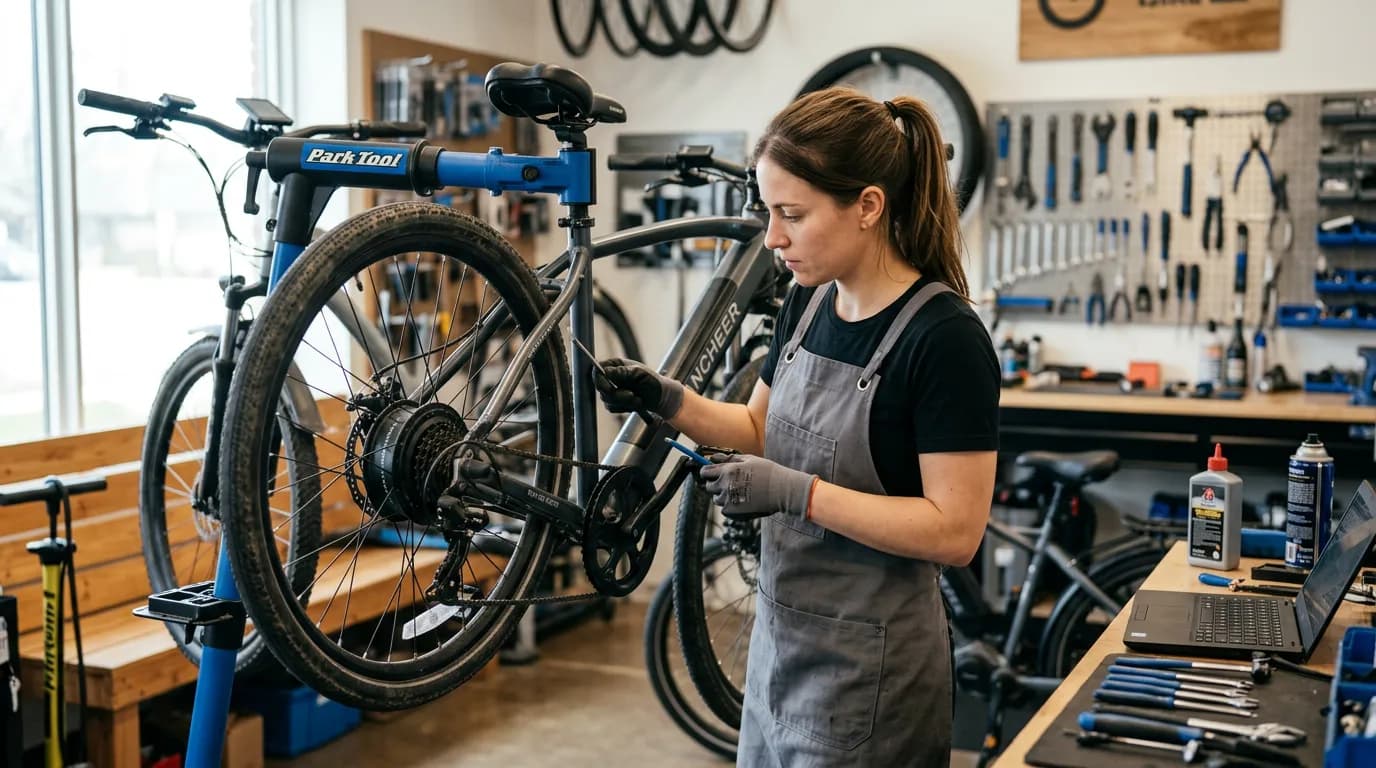
Inspecting an electric bike under $1000 starts with a systematic look at components that determine your safety and long-term repair costs, rather than just the aesthetic finish. Many budget models utilize proprietary parts that are difficult to replace, so a hands-on assessment of the frame, battery housing, and mechanical interfaces is essential before you commit to a purchase.
Key inspection points for your pre-ride audit
Check these critical areas upon delivery to ensure the manufacturer’s quality control aligns with your safety standards:
- Fastener integrity: Use an Allen key to ensure every bolt on the stem, handlebars, and seat post is torqued to spec. Vibration during shipping can loosen critical connections, and generic budget bikes often arrive with loose assembly points.
- Battery housing seal: Inspect the battery casing for gaps or misalignment. If the battery does not sit flush or the locking mechanism feels "mushy," you risk moisture ingress, which is the leading cause of early electronics failure in affordable PEVs.
- Rim and spoke tension: Lift the wheels off the ground and spin them to check for lateral wobble. Inconsistent spoke tension is common in lower-cost wheelsets and will lead to broken spokes within the first few hundred miles of commuting.
- Cable routing: Ensure no brake or derailleur cables are kinked or pinched against the frame. Sharp bends create friction, which accelerates cable fatigue and makes shifting or braking feel sluggish almost immediately.
Why "budget" shouldn't mean "unserviceable"
Even if you find a model that fits your price target, consider the 2026 E-Bike Longevity Audit by looking for standardized mounting points for common accessories like racks or fenders. Proprietary battery formats often trap you into buying replacements from the original retailer at inflated prices, whereas frames that accept industry-standard components allow for easier, cheaper upgrades as parts wear out.
| Inspection Area | Red Flag to Watch For | Long-Term Impact |
|---|---|---|
| Battery Port | Loose fit or exposed pins | Short circuits; fire hazard |
| Brake Cables | Sharp, tight angles at the headtube | Snapping during hard cornering |
| Folding Hinges | Lateral play or "clunking" | Frame stress and potential failure |
| Controller Box | Plastic housing with no seal | Moisture damage in light rain |
When you prioritize transparency and check these mechanical fundamentals, you reduce the likelihood of encountering the hidden maintenance costs of e-bike ownership that frequently plague budget buyers. Remember that a lower purchase price is only a value if the bike remains operational for years; if a component fails and cannot be serviced with off-the-shelf parts, the initial savings are quickly erased by downtime and repair labor. Always refer to your user manual to confirm which adjustments are user-serviceable and when you should consult a professional.
Frequently Asked Questions (FAQ)
Are electric bikes under 1000 dollars actually good for daily commuting?
Yes, they can be reliable for flat-terrain commuting if they are properly assembled and meet safety standards. However, they lack the high-torque performance and long-range battery capacity of premium models.
Is it better to buy a cheap new e-bike or a high-quality used one?
A high-quality used e-bike often provides better long-term value, as premium components and frames offer superior durability. A new budget bike is only recommended if it comes with a verifiable warranty and safety certifications.
What is the realistic range of an e-bike under 1000 dollars?
Most budget e-bikes deliver between 20 and 35 miles on a single charge. This range varies significantly based on rider weight, tire pressure, and how much pedal assistance you use.